PostgreSQL HA
Replication creates standbys. High Availability watches them, and promotes one to primary automatically when the primary fails.
Muppy builds this on pglookout (github.com/aiven/pglookout).
How it works
Muppy installs a pglookout daemon on each cluster of the RCS. Every daemon polls every cluster in the set at a fixed interval and works out which standby is best placed to take over. When the primary stops answering, and after a configurable delay, pglookout promotes that candidate.
Every HA event is logged in Muppy.
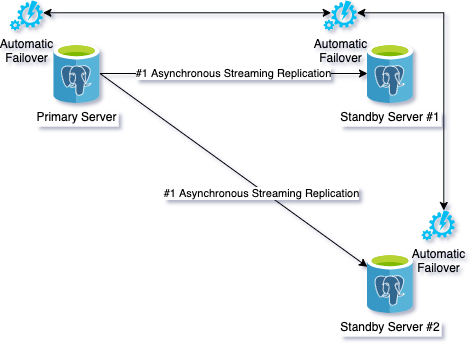
Three distinct functions:
- Collect replication statistics.
- Evaluate them to pick the best primary.
- Fail over automatically when needed — and this third one can be switched off during maintenance, or while you tune the HA parameters.
Everything is driven from the RCS form.
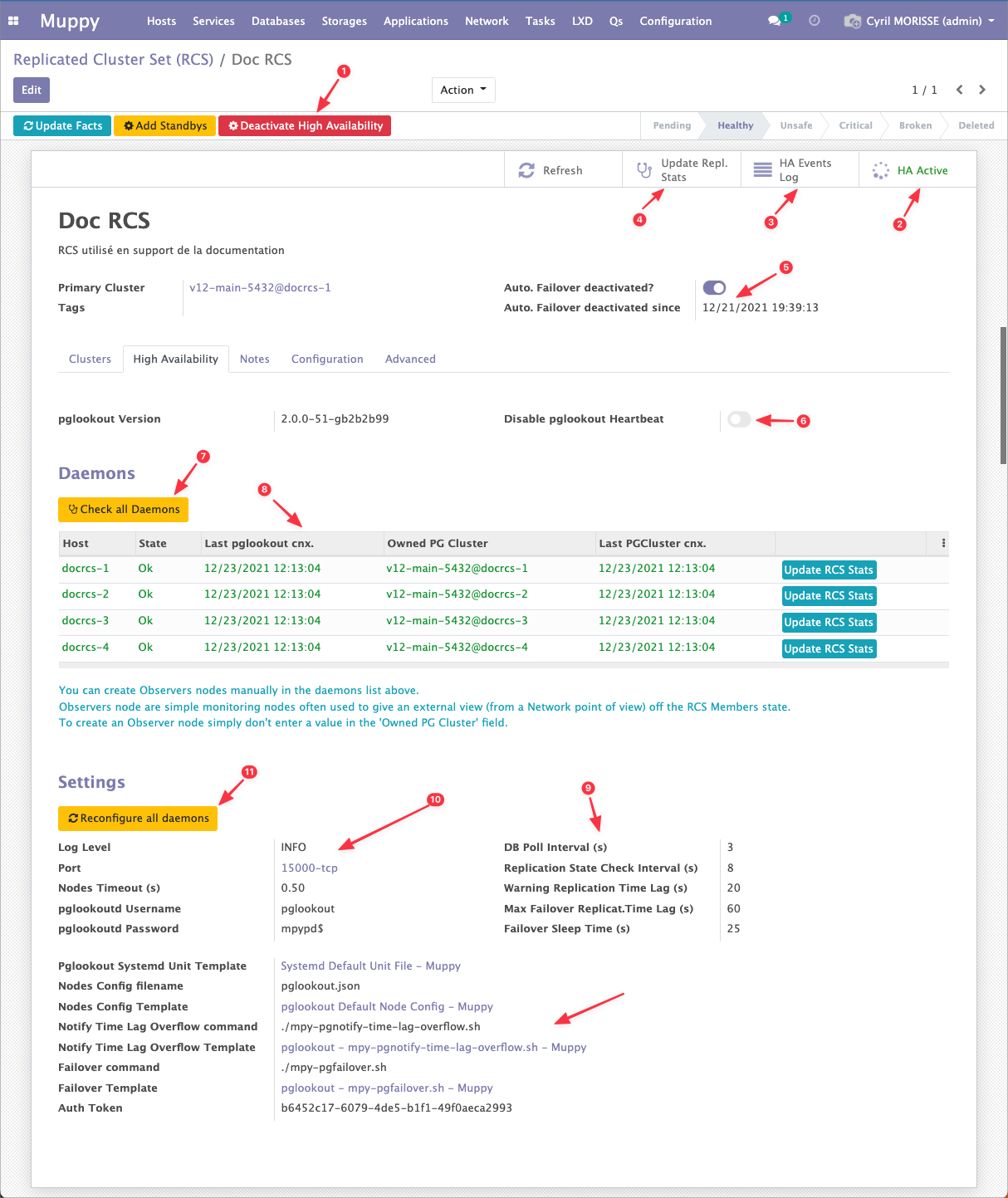
| # | Control |
|---|---|
| 1 | Activate High Availability / Deactivate High Availability — install or remove the daemons |
| 2 | HA status indicator (active or inactive) |
| 3 | HA Events Log — open the event log |
| 4 | Update Repl. Stats — refresh cluster replication statistics from the daemons |
| 5 | Auto. Failover deactivated? — automatic failover switch |
| 6 | pglookout Heartbeat switch |
| 7 | Check all Daemons — probe the daemons and refresh their status |
| 8 | The daemon list; click a line for its detail |
| 9 | Common HA parameters |
| 10 | Advanced HA parameters |
| 11 | Reconfigure all daemons — apply changed parameters |
Success
Every HA parameter carries inline help. Use it.
Rollout
Muppy also watches daemon and cluster availability through pglookout Heartbeat.